The Writer's Nest

By Akshita

    • About
    • Archives
    • Categories
    • Contact

  • Women’s Writing: Pride and Prejudice

    I have taken a Women’s writing course this semester. I have to admit that it’s a welcome relief after the hectic, super-technical courses of the last year; I can’t get over the idea that I get to read so much as a part of a course! Plus, the idea of reading and discussing women authors is all me.

    I wrote the following response to Pride and Prejudice as a part of our course. I hope you enjoy reading it. 🙂

    ***

    Introduction

    I first read Pride and Prejudice some four or five years ago. Having been a mystery-thriller reader, and not being used to the old sort of English, I quickly dismissed it as a slow, boring read. I read it again after some time, and presumably after reading great reviews about it which considered the book to be great literature. I suppose a part of me wanted to really like the book better because of the above mentioned reviews. And re-reading it definitely made me look at some of the things that I had perhaps missed the first time.

    About the book

    Simplistically speaking, Pride and Prejudice is a romance novel; “chick-lit” of the nineteenth century. Digging deeper, we find Austen talking about a wide range of concerns. It is a critique of the vanity of people of those times, the limitations and problems of the social and economic systems that were in place.

    pnp

    The characterization

    The deftly etched characters are the best part of the story according to me. Each character is thoroughly described. Also, each character is flawed, which is what makes the story interesting. The protagonist is not perfect, but human, and it is great to see her introspect on her follies and prejudices. She grows throughout the course of the novel, examining her conscience and changing. The change is gradual, for Elizabeth as well as Darcy, which makes it real.

    Apart from the main characters, I especially liked the character sketches of Mr. Bennet and Lady Catherine de Bourgh.

    The former seeks dry humour in every situation, be it annoying his wife, or the prospect of his family being turned out of their house by Mr. Collins. Only at one point do we see him truly anxious, trying to be a guiding father to his daughter, Elizabeth, when he talks to her about the cons of marrying Mr. Darcy. The part where he says that Elizabeth should be able to respect her partner is especially touching and shows that Mr. Bennet, though pretending to be unfeeling, actually understands his daughter very well. He quickly lapses back to his old self though. When he is told about Darcy’s role in Lydia’s wedding, this is his response:

    “… I shall offer to pay him [Darcy] tomorrow; he will rant and storm about his love for you, and there will be an end of the matter.”

     Mr. Bennet seems to have made peace with the chaos surrounding him in the form of his wife and his daughters. His dry humour seems to be a tool for staying sane.

    Lady Catherine is the personification of the arrogance of the privileged class. She serves the purpose of depicting all that Austen mocks or despises in her society. Completely overbearing and domineering, she has always got her way. Her love for dictating the terms to everybody is hilarious; especially when she takes such an active interest in the internal affairs of Collinses (and everybody else, for that matter).

    The following quote says it all:

    “What is that you are saying, Fitzwilliam? What is it you are talking of? What are you telling Miss Bennet? Let me hear what it is. Of music! Then pray speak aloud. It is of all subjects my delight. I must have my share in the conversation, if you are speaking of music. There are few people in England, I suppose, who have more true enjoyment of music than myself, or a better natural taste. If I had ever learnt, I should have been a great proficient… “

    The love stories

    The love story of Elizabeth and Darcy has become a cliché now; a battle of wits. But more than that, the gradual change that happens for both, Elizabeth and Mr. Darcy, is beautiful to watch.

    Darcy is shown to be reserved with his feelings; his pride is his only folly. In my opinion, barring his nature to speak arrogantly, there is nothing wrong with him. Meaning that, I admire that he does not engage in unnecessary pleasantries. He does not waste his time in small talk.

    Bingley on the other hand, does not do justice to his independence; for a person so wealthy and educated, he is quite easily swayed by other people. He is pleasant of course, but too mellow. The same is true for Jane Bennet; although her determination to see only the good in people stems from natural goodness, not weakness of mind. Both of them are non-confrontational and would like to keep everything pleasant. Bingley and Jane Bennet’s love story therefore is not very appealing.

    Sarcasm and humour

    A lot has been said about Jane Austen’s sarcastic wit. I have greatly enjoyed reading the way she mocks some of the social norms while remaining part of the society. The characters of Lady Catherine and Mr. Collins are excellent examples of this.

    The writing is funny and entertaining. Mr. Collins’ proposal to Elizabeth is one of the most hilarious scenes of the book. His utter lack of comprehension when Elizabeth declines his proposal is priceless. The almost immediate proposal to Charlotte Lucas afterwards also shows his fickleness.

    The banter of Mr. and Mrs. Bennet is also very enjoyable.

    Feminism and social standing

    The novel presents many feministic ideas and criticisms of classism, albeit in a very subtle manner. Austen talks about various important matters, such as the need to marry “sensibly” (for men and women, both), the entailment of estates only to a male relation, the perceived notions of trade as a slightly less respectable profession.

    Elizabeth is shown to have a mind of her own; she is not afraid to have opinions. I like that she is disappointed when Charlotte marries Mr. Collins for financial security and status. Even though her disposition is to let bygones be bygones, I think she never really regains her respect for Charlotte completely.

    Let me draw attention to the highly entertaining conversation in which the qualities of an accomplished woman are discussed. Through Elizabeth, Austen says that expecting women to be perfect is unrealistic. Women should be allowed to be flawed and human; the expectation of a goddess is as bad as generalizing women as less intelligent.

    Although Austen’s thoughts are in the right direction, the novel loses some of its charm for me when it comes to everyday sexism and classism. A disappointing amount of importance is given to outer appearance. For example, the Bennet sisters are shown as deserving good marriages because they are beautiful. Men are also expected to be rich, handsome and of a high social standing.

    A whole lot of attention in Pride and Prejudice is given to women finding or trying to find husbands. And even in this endeavour, there is a lot to be considered apart from love. For instance, the character of Mr. Collins is caricatured in such a manner that as a reader, I cannot help being repelled by him. Austen tries to show that despite being wealthy enough and having a respectable position in the society as a clergyman, he is undeserving of Elizabeth because he is boring and insensible. But at the same time, when we come to Darcy, we also consider his wealth and rank while deciding his worth. The following quote makes this evident:

    “In spite of her deeply-rooted dislike, she [Elizabeth] could not be insensible to the compliment of such a man’s affections…”

    I wonder why Austen is so critical of her own gender at times. Of course, she considers women to be equally competent as men. She would not have written a character like Elizabeth Bennet otherwise. But she too plays into the stereotypes about women. Mrs. Bennet is shown to be foolish and ignorant. Mr. Bennet, while appreciating Elizabeth’s intelligence, remarks that she is “not like other girls”, thus generalizing that all other girls are silly. Lady Catherine de Bourgh, the only woman in the novel who is financially independent, is horribly arrogant and interfering, and takes an inappropriate amount of interest in others’ lives. This confirms to the stereotype of the problems of giving power to women.

    Conclusion

    Even after reading the book several times, and at different points of time, I am still unable to decide whether I like it or not. It is definitely an easy, light read. The “tragedies” are not exactly earth-shattering; one can read it in a detached manner, without becoming too involved in the story. That can be a positive or a negative point depending on the mood. The story and the characters do bring a smile on the face. The unintended, subtle sexism makes it somewhat less enjoyable. But I can make allowances for it, as the book was written two centuries ago. The book remains a beautiful satire on the hypocrisies and drama of the English gentry.

    Share this:

    • Share on X (Opens in new window) X
    • Share on Facebook (Opens in new window) Facebook
    • Share on WhatsApp (Opens in new window) WhatsApp
    • Share on Pocket (Opens in new window) Pocket
    • Share on Tumblr (Opens in new window) Tumblr
    • Share on Pinterest (Opens in new window) Pinterest
    • Share on Reddit (Opens in new window) Reddit
    • Email a link to a friend (Opens in new window) Email
    Like Loading…
    September 16, 2014
    Category: Books
    Tags: Book, Books, Feminism, Jane Austen, Pride and Prejudice, Women, Women’s Writing

  • Broken

    Download / By Sunset Girl

    She stood waiting, unsure whether to sit. It was an empty room mostly; a green, old and worn-down sofa, a chair with a broken back, a small table. A small, grilled window looked out to the busy street; a lot of noise. But she did not hear the noise; the turmoil inside her was too great in itself.

    It had been three years since Maya had last seen her father. A small time, really, but she had lived a whole new life during that time. Resentment, anger and shame had filled her in those initial days. Now, it was replaced by dread. She had a thousand questions for him, but no words.

    The door opened and her father entered. He had not changed much, nothing that struck her. It was almost too easy; there was no shock that is usually present when you see someone after a long time. It was, as if, a continuation of the past, as if no break had taken place. It scared her more.

    He shuffled over to the sofa and sat down with a grunt. She was somewhat hurt. Had she hoped for some change? Had she perhaps expected an apologetic behavior, awkwardness mixed with sorrow? Shame? Remorse? It bothered her that even after such a long time, this small act by her father affected her so much.

    Positioning herself on the chair, she looked resentfully at him. She had thought that time would heal the wounds, or would at least make her detached enough for this meeting. But she was still so trapped into all those emotions. She wanted to get up and run away. She wanted to hit him. She wanted…anything, anything that would release that burden that had been making her shoulders, head, her entire body, ache for three years.

    He broke the silence.

    “Maya… You’ve been well…?”

    Such a cursory question, something that she would have answered immediately at a social gathering; Yes, very well. Thank you! But she wouldn’t answer today. She hadn’t come here to have pleasant chats about the weather, ignoring the elephant in the room. She had come to…to… Why had she come here? She asked herself again. She still had no definite answer.

    “You have been well?” she asked, unable to keep her tone less accusatory.

    “Ah, yes, well… The neighborhood is nice.”

    A silence again.

    He stood up and shuffled inside. A minute later, he came back with a glass of water and a plate of biscuits.

    “You liked these ones… Marie biscuits…” he ventured.

    A pain had now settled in her heart. This was difficult, more difficult than singular hatred for somebody.

    *

    “Daddy! Look what I brought!” Maya shouted with glee, holding the trophy in her hands.

    She burst into the house, but her father wasn’t in the drawing room. Impatiently, she ran back to the kitchen garden; her father was very big on home-grown vegetables.

    Kitchen…Living room…Study… Maya rushed upstairs to find him. The door to her parents’ bedroom was half closed. She pushed it open. He was there…

    *

    The maid came running at the sound of the glass shattering.

    It had shaken her, that she was still so possessed by old nightmares; incidences that she had thought to be buried. She wasn’t ready to do this, wasn’t ready to look into her father’s eyes.

    The ride home was uneventful. Her taxi passed through familiar streets but she was lost in a whirlpool of her emotions.

    She regretted her decision.

    *

    The girl was too scared to scream. And she was so tiny; she couldn’t have battled a man of her father’s size alone. In fact, both of them together could not have made a difference either. But Maya’s father stopped on seeing her enter the room. He didn’t say anything. Maya would not let him. She could not stop screaming. The girl rushed to Maya as soon as her Daddy’s hands loosened. She was trembling with fear and still couldn’t say anything. Maya couldn’t say anything coherent either. It was all a jumble of words; accusations and disgust.

    *

    The taxi came to a stop at her hotel, and broke her flow of memories; memories that she had locked deep within, and which were now open and unwilling to be subdued easily. She still shuddered to think of what would have happened had she not reached her house in time. More than that, she shuddered to think what would have happened had she stopped screaming and allowed her father to talk. Her father was never at loss for words. He was a lawyer; he would have made such convincing statements. And she knew she would have believed him. Like she had all her life.

    She returned home the next morning.

    *

    Sitting in her psychiatrist’s office,  Maya could not help remembering the faint memories of her childhood… how Daddy used to wink at the waitresses, and then laugh innocently when he caught her looking…how he would stare at women who passed by them every morning while they went for walk in the park. Had he always been a pervert? Had she just been too trusting or too preoccupied to notice?

    *

    Her father acted as if nothing was wrong, as if the very basis of all relationships with him hadn’t changed. Her mother had been too ashamed to speak to her. The girl, her father’s student, hadn’t made any complaint. A lot of money was involved.

    Why did her mother choose to turn a blind eye towards his follies? What happened to all her teachings about truth and pride? Why did the girl not speak up? Maya could not decide whose behavior troubled her more.

    *

    She promised herself that she would return again some day; when it would be less painful, less humiliating, less … personal. She would then return as just a researcher, merely curious to know the mind of a criminal. Till then, this story would remain broken.

    Share this:

    • Share on X (Opens in new window) X
    • Share on Facebook (Opens in new window) Facebook
    • Share on WhatsApp (Opens in new window) WhatsApp
    • Share on Pocket (Opens in new window) Pocket
    • Share on Tumblr (Opens in new window) Tumblr
    • Share on Pinterest (Opens in new window) Pinterest
    • Share on Reddit (Opens in new window) Reddit
    • Email a link to a friend (Opens in new window) Email
    Like Loading…
    August 21, 2014
    Category: Stories
    Tags: Daughter, Estrangement, Father, Fiction, Relationship, Sexual Harassment, Stories, Story

  • Anchored

    By Kholodnitskiy Maksim
    Photo by Kholodnitskiy Maksim

    Unsure of myself,

    I stepped on the dock.

    A flurry of activities was going on.

    Great cries could be heard;

    People calling out to each other.

    Young boys in their light cotton shirts,

    Hauling their trunks to the ship.

    Young girls, standing bravely;

    Dreams and ambitions in their poise.

    All saying farewell to their mothers,

    Their fathers, brothers, sisters, friends.

    But most of all, saying goodbye

    To the lives that they had known.


    And then, there was me,

    Confused, terrified, incongruous.

    I had my trunk and my ticket too.

    I was there ahead of time.

    And yet, I stood rooted on the spot,

    Fighting with myself.

    For I could see the promises

    Of the land at the end of the sea.

    And I could see the beauty

    Of the land behind me.

    The ship now blew its final horn,

    And yet my feet were anchored still;

    I could not decide.


    Time stands still while I write this.

    And at the end of this moment,

    Perhaps I shall know.

    Share this:

    • Share on X (Opens in new window) X
    • Share on Facebook (Opens in new window) Facebook
    • Share on WhatsApp (Opens in new window) WhatsApp
    • Share on Pocket (Opens in new window) Pocket
    • Share on Tumblr (Opens in new window) Tumblr
    • Share on Pinterest (Opens in new window) Pinterest
    • Share on Reddit (Opens in new window) Reddit
    • Email a link to a friend (Opens in new window) Email
    Like Loading…
    August 15, 2014
    Category: Poetry
    Tags: Ambition, Change, Decision, Dreams, Poem, Poetry

  • The Rainy Day When I Forgot To Make A Boat

    I know it’s been a while since I’ve posted. I’ve got a LOT of stuff going on. It’s a period of learning new things, relearning old things, and the most difficult of all, waiting. I never rated myself high on patience anyway, but this has been the ultimate test.

    Today was an idle day for a change. And a heavenly one; the rains look beautiful from our windows! I happened to be home from university. It was nice sitting with my parents, quietly, enjoying the rains.

    raindrop

    There were children playing in the little water puddles. Looking at them, I suddenly sat up, thinking.

    “What happened?” my mother asked.

    A few seconds later I replied.

    “I’ve forgotten how to make a boat!”

    You know the ones; origami boats that we used to make in school. The ones we put in the water puddles during the rains.

    Getting hold of some paper, I immediately started making one. I couldn’t see the steps in my mind at once, but my hands remembered. I guess this is one of the things that is like riding a bicycle; you don’t forget.

    “Turns out I do remember how to make a boat.” I grinned at my mother.

    I suppose this could have been the point where my mother told me to stop being ridiculous and grow up. Ha! She taught me how to make a ship! 🙂

    boat


    Share this:

    • Share on X (Opens in new window) X
    • Share on Facebook (Opens in new window) Facebook
    • Share on WhatsApp (Opens in new window) WhatsApp
    • Share on Pocket (Opens in new window) Pocket
    • Share on Tumblr (Opens in new window) Tumblr
    • Share on Pinterest (Opens in new window) Pinterest
    • Share on Reddit (Opens in new window) Reddit
    • Email a link to a friend (Opens in new window) Email
    Like Loading…
    July 29, 2014
    Category: Life in moments
    Tags: Boat, Family, Mother, Origami, Rain

  • Winds Of Change

    Photo by Tirza van Dijk

    An autumn leaf fell by my side;

    It was time for a change.


    The first leaf that fell

    Shook me out of my reverie.

    I had been planning for summer.

    The wind washed away my plans

    As that first leaf fell in the water.

    I looked on, unable to move.


    I watched powerless

    As the leaves withered by.

    I tried to hold on to summer,

    I tried to hold on to blooms.

    But the leaves withered away,

    And left me in a sea of yellow.


    Somewhere below the yellow

    My plans lay scattered.

    How could I have not seen this coming?

    How did I miss the change in air?

    How did I not see the scurry

    Of all those around me?


    Was I the only one unprepared?

    Was I the only one on whom

    The autumn crept upon stealthily?

    The change paralyzed me for a moment.

    A fear settled in my heart;

    Maybe winter would come too.


    But taking a deep breath I vowed

    That the first fall of snow

    Will not be an abrupt shock.

    This time, I shall be awake.

    This time, I shall be welcoming.

    For plans are meant to change.


    The first flake of snow

    Shall not be my autumn leaf.

    Share this:

    • Share on X (Opens in new window) X
    • Share on Facebook (Opens in new window) Facebook
    • Share on WhatsApp (Opens in new window) WhatsApp
    • Share on Pocket (Opens in new window) Pocket
    • Share on Tumblr (Opens in new window) Tumblr
    • Share on Pinterest (Opens in new window) Pinterest
    • Share on Reddit (Opens in new window) Reddit
    • Email a link to a friend (Opens in new window) Email
    Like Loading…
    June 24, 2014
    Category: Poetry
    Tags: Autumn, Change, Permanence, Poem, Poetry, Winter

  • On Vulnerability, Bravery and Failure

    Trying out new things; the thought makes my stomach plunge a little every time. You know the feeling; a sudden jab of fear, adrenaline, and a worse version of “butterflies-in-the-stomach”. In general, stepping out of your comfort zone, leaving behind “what you know” invokes similar feelings.

    I’m generally very good at identifying “what I know”. While that can be a valuable quality to have in various situations, it is also a liability in personal development; I form unnecessary boundaries and define limits for myself.

    This is not my thing: not making an attempt.

    I’ll try my best but I’m warning you, I’m not very good at this: being apologetic in advance.

    I know what all of these statements mask. A fear of failure. What if I try it and find out I’m not good at it? I won’t even try. What if people see me fail? I’ll claim I knew it in advance. All the while hiding behind a claim of self-knowledge and a show of courage.

    I’ve spent a lifetime in a cocoon. I’ve cottoned my surroundings to lessen the impact of any stumbling block.  All my life, I’ve held on to things that I know I’m good at. It has stopped me from giving a chance to things that I could have tried and probably enjoyed. And yet, I know I’m missing something; exhilaration. Devoting your whole and soul to something and simply hope for the best.

    The past semester has taught me various things. Getting past the feeling of vulnerability is one of those things. I’ve tried to put myself forward, right into that uncomfortable spot, in small, everyday moments of life, consciously. A prick of fear, many moments of “What was I thinking!” and a final dogged attempt later, I’ve always feel glad of attempting the uncomfortable. And in most cases, it hasn’t been that bad. A lot of my inhibitions have been over-exaggerated and sometimes, downright irrational.

    In this past semester, I’ve made myself face small challenges every day. I’ve tested and flexed what I thought my boundaries were. I’ve launched heads-on into things that make me uncomfortable. The results have been satisfying. I’ve found new strengths. I’ve discovered a depth in my capacities that I never knew of.

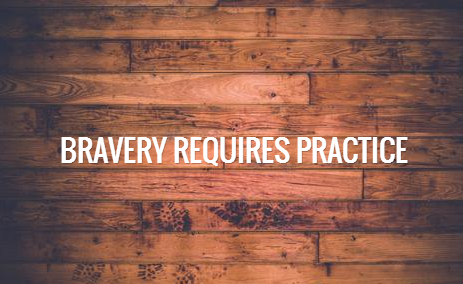
    Unfortunately, I’ve found out that such attempts, while very enlightening, have not changed my basic instinct. Which is to save myself from failing. A few days of comfort, and coming back to facing vulnerability is as difficult as ever. Bravery then, is a product of not one (or a few), but many such attempts.

    bravery3.jpg

    This is my goal now; to continue to challenge myself every day, to try my hand at something new, to conquer that discomfort felt in the pit of my stomach. My goal is to fail, perhaps in the eyes of the world, so that I do not fail myself.

    Share this:

    • Share on X (Opens in new window) X
    • Share on Facebook (Opens in new window) Facebook
    • Share on WhatsApp (Opens in new window) WhatsApp
    • Share on Pocket (Opens in new window) Pocket
    • Share on Tumblr (Opens in new window) Tumblr
    • Share on Pinterest (Opens in new window) Pinterest
    • Share on Reddit (Opens in new window) Reddit
    • Email a link to a friend (Opens in new window) Email
    Like Loading…
    June 2, 2014
    Category: Life in moments, Random Musings
    Tags: Bravery, Comfort Zone, Failure, Fear, Personal Growth, Vulnerability

  • Patience

    Photo by Danka Peter

    I waited while you looked around

    Trying to find a place for yourself

    In the crowd surrounding us.

    I waited while you held on to beliefs

    That were untrue and unfair.

    I waited while you grasped about

    Trying to make sense of what I am.

    It is not easy, I give you that,

    To make sense of a person.

    And so, I waited patiently for you.


    You walked on ropes,

    Putting one foot demurely after the other,

    Tracing back to your comfort, once, twice.

    I waited, as you finally let go

    Of the hold of old notions

    And walked in air trying to balance it all.

    You were very brave

    To leave what was your truth

    In order to find what was mine.

    Hence, I waited patiently for you.


    You rushed the last few steps

    And fell into my arms

    As a child would fall while learning to walk.

    I waited very patiently

    While you gathered your jumbled emotions.

    Confusedly, you looked at one emotion

    Trying to understand it.

    It is not easy, I give you that,

    To make sense of one’s emotions.

    And thus, I waited patiently for you.


    You have now, perhaps, made up your mind.

    You have now formed an opinion of me.

    But you still look around for words.

    I’m still waiting patiently for you

    For it is not easy to form bonds.

    It is not easy to give a part of oneself to another.

    It is not easy, I give you that,

    To leap with faith into unknown.

    I’ll wait patiently for you to close your eyes

    For leaps of faith are best made when blind.


    But while your eyes are open

    See, that I have made a leap of my own

    For it to come to this.

    While your eyes are open

    See the smile on my face,

    See the trust in my eyes.

    It is not easy, I give you that,

    To see the gift that my leap has given me.

    I’ll wait patiently for you to see

    What cannot be, with eyes open, seen.


    Share this:

    • Share on X (Opens in new window) X
    • Share on Facebook (Opens in new window) Facebook
    • Share on WhatsApp (Opens in new window) WhatsApp
    • Share on Pocket (Opens in new window) Pocket
    • Share on Tumblr (Opens in new window) Tumblr
    • Share on Pinterest (Opens in new window) Pinterest
    • Share on Reddit (Opens in new window) Reddit
    • Email a link to a friend (Opens in new window) Email
    Like Loading…
    May 28, 2014
    Category: Poetry
    Tags: Friendship, Poem, Poetry, Prejudice, Trust

  • You Lied, Mother

    ‘Leaving the Nest’ by Siobhan Knox

    You lied, Mother.

    You said it will be easy.

    You said the world was a beautiful place to grow up.


    You pushed me gently out

    Coaxing me to go a little more,

    Just a little further on the branch.

    You told me not to be afraid

    As the wind swayed me about.

    You lied, Mother.

    You said I will not fall.


    I took off, nearly toppling,

    In what was a miserable attempt at flight.

    The nest seemed so far off,

    Its thought itself so cozy.

    You told me to enjoy the sunlight on my face.

    You lied, Mother.

    You said the world was warm.


    You said I will not fall.

    I fell many times,

    Hard on my face, flat on my back.

    You said the world was warm.

    It cold-shouldered me,

    Its tragedies chilled my bone.

    Why did you lie, Mother?


    The world keeps telling me

    That each time I fell, I failed.

    It keeps reminding me of my bloodied nose,

    Of my injured, drained body.

    Is that why you lied, Mother?

    So that I would be unable to see

    My falls as my failures?


    The world keeps closing its doors

    Leaving me out in snowy, wintry days.

    It teases me by lighting fires far from my reach.

    Evoking desires of what is not mine.

    Is that why you lied, Mother?

    To give me this gift

    Of warm satisfaction with my flight?


    Your lies have made me blind.

    Your lies have made me strong.

    You lied, Mother, but I forgive you.

    Share this:

    • Share on X (Opens in new window) X
    • Share on Facebook (Opens in new window) Facebook
    • Share on WhatsApp (Opens in new window) WhatsApp
    • Share on Pocket (Opens in new window) Pocket
    • Share on Tumblr (Opens in new window) Tumblr
    • Share on Pinterest (Opens in new window) Pinterest
    • Share on Reddit (Opens in new window) Reddit
    • Email a link to a friend (Opens in new window) Email
    Like Loading…
    May 14, 2014
    Category: Poetry
    Tags: Children, Growing up, Leaving the nest, Love, Mother, Motherhood, Parenting, Parents, Poetry

  • A Fair World

    It was more than a decade back. The Navratri celebrations in our society had Garba competitions. (I’ve talked about Navratri and my love for dancing here. For the new readers, Navratri is a nine-nights long dance festival. Garba is the dance form). It was announced that the dancer who dances continuously the entire night (excluding official breaks) will win.

    I was nine, passionate and a fairly good Garba dancer. I held a wish in my heart. I wanted to win. Working up the will, I danced tirelessly. I did not stop when there was barely space enough to dance.  I did not stop when the crowd lessened. I did not stop when my body started aching. I danced the entire night.

    It was time for the prize ceremony. I was feeling elated. I had danced more than ever before. I had had more fun dancing than ever before even though I was tired. I was proud of myself. I had achieved something that I hadn’t thought myself capable of.

    I did not get the prize. It went to the organizer’s daughter. At the risk of sounding, well, childish, I should mention that she did not dance for even one complete hour. I don’t have an accurate or objective memory of her dancing skills.

    It was the first time I learnt that the world isn’t fair. You may not always sow what you reap. You may not always get the fruits of your hard work. You may not get any acknowledgement or appreciation for giving your whole, undivided devotion to something. I was too idealistic. The realization broke my heart.

    Over the years, I’ve mainly had good experiences in this matter; most of my efforts have been rewarded. But then, there have also been a few experiences where I’ve felt wronged, resentful, betrayed. Experiences, where the child in me wants to cry out, Unfair! and fold her arms in indignation, frowning, and going all Calvin.

    I identify myself with the work that I do. I gain satisfaction from a job well done. Anything less than perfect eats at me, though I’ve been working on not letting it affect me. The point is, I pride myself on working wholeheartedly. When that work is not appreciated, it hurts me. And there is not a lot that really hurts me. I suppose it is not healthy to depend on rewards for satisfaction. And don’t get me wrong; it is not the materialistic rewards that I seek; merely recognition for my efforts.

    It is an age-old adage that one shouldn’t work for the fruits, just the satisfaction. And that Karma takes care of everything. Eventually everything works out for the best. I would be lying if I said that I do not believe in it. There is some part of me that is still idealistic, that still believes that rewards will come, albeit not in the form that I expected. But then, there’s this other part of me, a somewhat pessimistic part. A part that has been asking these questions lately:

    Is it enough to get returns in another form?

    The balance may turn out to be all right at the end of the balance sheet but is life mathematics, with each wish, each reward having an equal value? Aren’t some dreams and efforts worth more?

    And at the end, when we feel satisfied at least with ourselves, is that satisfaction real or merely a consolation that we fool our hearts with?

    These are some questions that I’ve been grappling with, especially the last one.

    This is my answer to it:

    I shall continue to put in my best efforts in whatever I do. I do not know any other way to work. The satisfaction of it, consolation or not, is very real to me. But at the same time, it is important to be worldly wise too. It is important to know where to draw the line between working tirelessly and getting taken advantage of.

    I still do not know all answers. I still want to learn.

    What has been your experience?

    Share this:

    • Share on X (Opens in new window) X
    • Share on Facebook (Opens in new window) Facebook
    • Share on WhatsApp (Opens in new window) WhatsApp
    • Share on Pocket (Opens in new window) Pocket
    • Share on Tumblr (Opens in new window) Tumblr
    • Share on Pinterest (Opens in new window) Pinterest
    • Share on Reddit (Opens in new window) Reddit
    • Email a link to a friend (Opens in new window) Email
    Like Loading…
    May 6, 2014
    Category: Life in moments, Random Musings
    Tags: Hard Work, Justice, Personal Growth, Satisfaction

  • Walled

    Note: Sorry for the long absence. I’ve had a great time being busy and working hard. 🙂 In the coming posts, I shall be writing about a lot of things that I’ve learnt in the past few months. But for now, here’s a poem.

    This is a backlit photo of a girl sitting in a chair.
    Photo via Pinterest

    My poetry is a window

    To the chasms of my heart.

    My words are cloaked by a veil

    That only some can tear apart.


    I weave into ink

    What cannot be said.

    My poetry is a pattern

    Of the mosaic of my soul.


    I shall stop writing

    The day someone discovers

    The chink in my armour,

    The crack in my wall.


    For then, it will all be out.

    All  fears and dreams;

    My desires, all naked

    For strange eyes to see.


    For then, I shall be unclothed.

    But for now, I can’t stop.

    For now, I have to write.

    Or else, the words will die.

    Share this:

    • Share on X (Opens in new window) X
    • Share on Facebook (Opens in new window) Facebook
    • Share on WhatsApp (Opens in new window) WhatsApp
    • Share on Pocket (Opens in new window) Pocket
    • Share on Tumblr (Opens in new window) Tumblr
    • Share on Pinterest (Opens in new window) Pinterest
    • Share on Reddit (Opens in new window) Reddit
    • Email a link to a friend (Opens in new window) Email
    Like Loading…
    April 30, 2014
    Category: Poetry
    Tags: Desire, Fear, Poet, Poetry

Previous Page Next Page

Blog at WordPress.com.


Loading Comments...
 

    • Subscribe Subscribed
      • The Writer's Nest
      • Join 285 other subscribers
      • Already have a WordPress.com account? Log in now.
      • The Writer's Nest
      • Subscribe Subscribed
      • Sign up
      • Log in
      • Report this content
      • View site in Reader
      • Manage subscriptions
      • Collapse this bar
    %d