It’s Diwali: The festival of lights. The festival of crackers, earthen lamps, Rangoli, sweets, new clothes. The last day of the Hindu year. The festival of good finally winning over evil. You can read more about it here.
And there’s also cleaning. 🙂
Yeah, every year before Diwali, all people clean their houses from top to bottom. They rid their lives of clutter and welcome the new year with a clean and fresh outlook. I think it’s a wonderful tradition! Because, the material clutter often leads to mental clutter.
Like each year, the stuff in the cupboards comes out, the drawers are emptied of unwanted knick-knacks and papers. Only the things that matter are retained. Which brings me to our own drawers.
All my family is fond of music. I’ve grown up listening to old Lata Mangeshkar songs and classical music and Ghazals. And of course, my dearest, Madan Mohan! It was because of my family that I developed a taste for old Hindi music, and they learnt to appreciate new age music with me.
We had a huge collection of cassettes; Mum’s Mohd. Rafi and Asha Bhosle songs collection, Papa’s Jagjit Singh albums, my nursery rhymes and fairy tales! Though I can’t say they loved my cassettes particularly (How often can a grown-up listen to Mary had a Little Lamb?), I grew to love their cassettes and music immensely.
Well, times change. The age of digital music is here. So now it’s CDs (they’re getting old too, I know) and iTunes. And yes, it’s convenient and space-friendly and everything, but… But I sometimes miss the cassettes. And the fact that I had to listen to three boring songs before I got to the one that I really liked. (Using the Forward button too much spoilt the cassette). I remember we had a Philips tape-recorder-cum-cassette-player. And a walkman. And at least three pocket radios. And of course, the bigger radio. All of them have gone out of fashion and our home. We still have a stereo that can play cassettes apart from the CDs and the radio, but the cassette playing part doesn’t always work due to lack of use.
This Diwali, we also got rid of a major part of our cassette collection. We’ve retained some classic collections and I’ve been given the job of finding those songs in a digital format. End of an era for me!
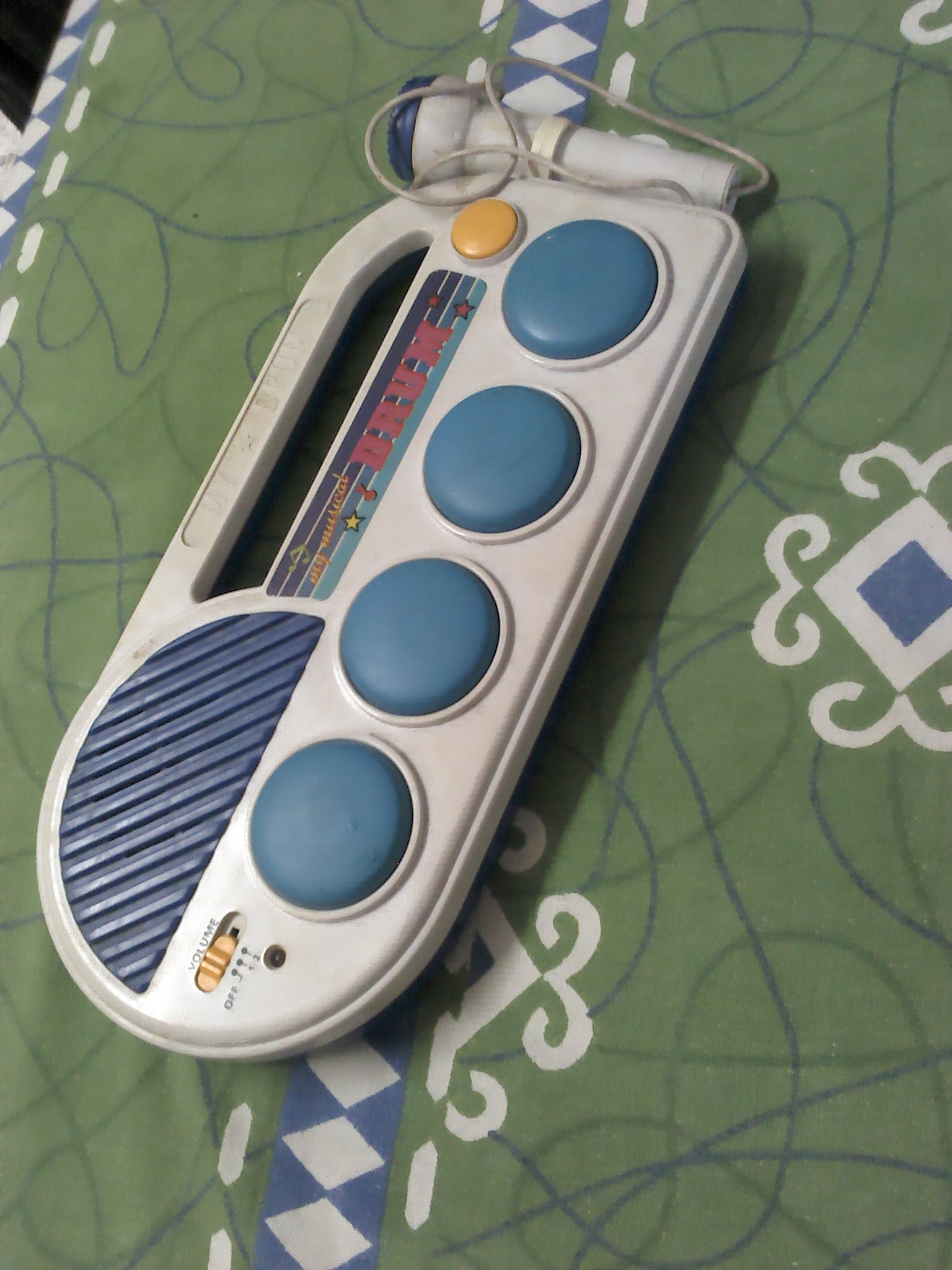
I found another thing too. That’s my first brush with music playing. 🙂
I, of course, then moved on to bigger and better things. We have a Harmonium and a mini keyboard too. The harmonium is my father’s; my Mum used to sing and sometimes play. (She still sings by the way; the past tense is for the playing). When I learnt singing, the harmonium was my companion too. Though I never formally learnt how to play the Harmonium or the keyboard, I could carry simple tunes. Still can, I believe. 🙂
But we don’t. Not very often. With other things taking priority, the harmonium and the keyboard are packed away. But they’re treasures and we would never give them away.
I gave away the music set pictured above, though. Along with some more of my old toys; I can’t seem to be able to part with all of them at once and have to wait every year to give some. It’s difficult, isn’t it? To give away one’s childhood. For most things, I’m not that sentimental. I’m good at getting rid of unwanted things. I don’t normally get attached to them all that much. And I very much realise the importance of cleansing one’s life. But there are certain things for which I convince myself with difficulty.
But I digress. I haven’t yet told you about the part I enjoy a lot during Diwali: Rangoli making. It’s made of coloured sand, and flowers and anything really. You just need colours. Like a temporary mosaic on the floor. Here’s what mine looks like this year. I kept it small and simple.
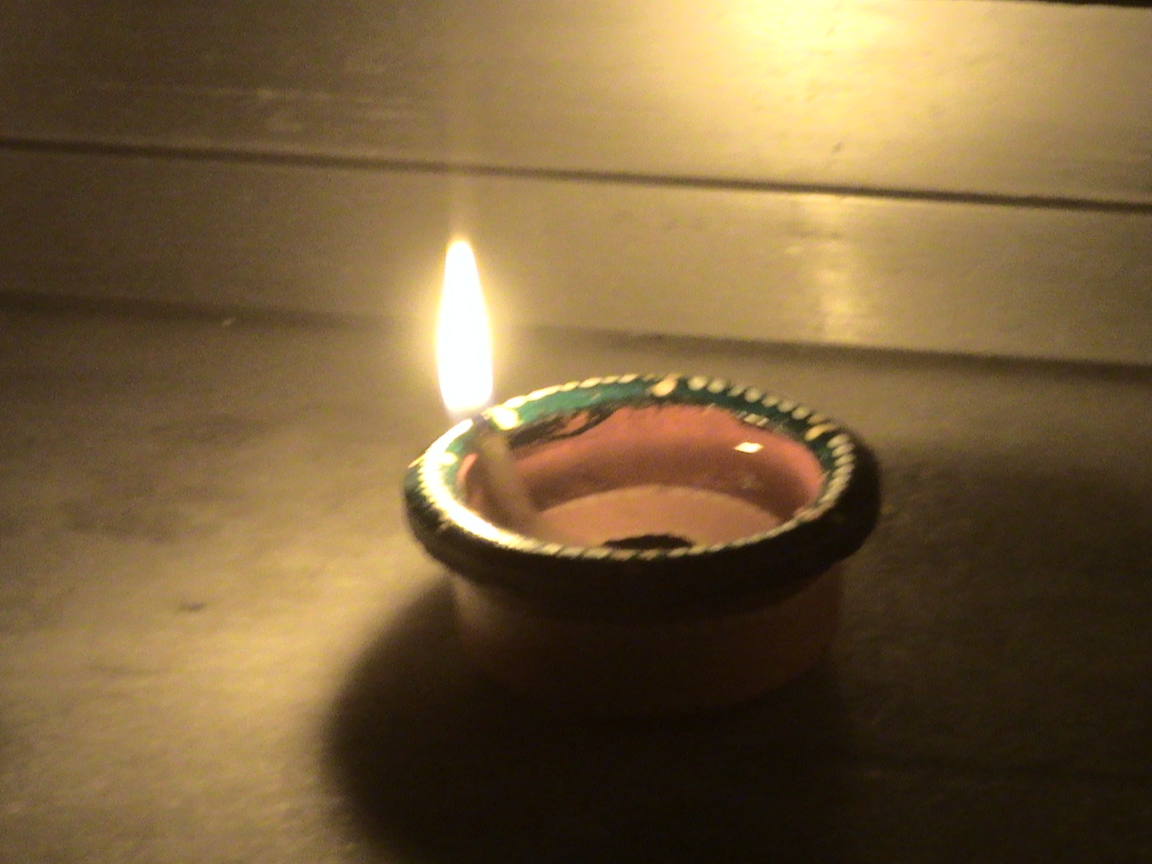
Another part that I love is the lighting of earthen lamps. There’s something about the diya flames, isn’t there?
I hope everyone has a great Diwali and a wonderful year ahead. 🙂
I remember exactly the first time I lied to be thought virtuous. It was a school test. It had general questions. One question was this: Do you help your mother around the house regularly? I’ll ignore the assumption that only “mothers” are supposed to work around the house for now. I wrote “Yes” as the answer.
Now I did help around the house. Sometimes. When I felt like it. It wasn’t a compulsion or a duty or anything. If I was asked to do something, I did it sometimes, sometimes I refused saying I was doing important things like playing. It wasn’t a big deal. So the true answer would have been “Sometimes”. But we were asked to answer in just Yes or No.
I wrote Yes because of two reasons. One was to account for the “Sometimes”; I didn’t think it was fair to ignore all of the work that I did in the face of the times that I didn’t. The second reason brings us to today’s topic: I wanted the teacher to think that I was good.
What does being good mean exactly?
A simple definition would be to be kind, generous, helpful to the people around you. But these words themselves are pretty vague as far as their own definitions are concerned. What does being kind mean? What is the line between being generous and being taken advantage of? What constitutes help and where do we stop it?
Being selfless combines all of the above if we look at it simplistically. And selflessness?
Altruism: the quality of unselfish concern for the welfare of others.
To be unselfish?
A selfish person is one “lacking consideration for other people; concerned chiefly with one’s own personal profit or pleasure.”
I refuse to believe that anybody is completely selfless. All of us are selfish in varying degrees. And all of us know it deep down. And it’s not such a bad thing. Why then, this need to be considered “selfless” by others?
I think I’m considerate enough towards people as a general rule. I think I help them reasonably; not doing their entire work, of course, but as much as is genuinely needed. If had to choose a path that benefits everyone, I would choose it over the one that benefits just me. I would try and avoid the path that hinders others. But if there was a choice between a path benefits somebody else but harms me in any way, I don’t think I’m selfless enough or virtuous enough to choose it. I don’t think I can let anyone matter more than me.
It sounds harsh when I say this perhaps. But I don’t think I’m wrong. There’s a difference between being good and being taken for granted. I have no qualms in doing something for another being; I can take a little bit of trouble for it. Because it makes me feel good. I have to admit that it is about me even then. It is always about me.
And yet, we have this inherent need to be considered good by others, especially when we are young and in school. Hence, I have to tell my teacher that I’m “helpful” and “obedient” in my house. I have to share that last bit of cake with my classmates even though it is my favourite and I don’t want anybody else to eat it. But I have to share because I’m good and “generous”. I have to help people with their homework because I’m a “kind” person, and it doesn’t matter that they gave some superficial excuse not to do it. Otherwise, I shall be considered “selfish”. It’s okay if I’m not actually good inside my head, with my thoughts, as long as I’m being considered good by the world.
It has become easier to think for myself first and then others as I’ve grown older. But as a society, we continue to expect people to confirm to these behaviours. Don’t get me wrong. The children have to be taught these things, even if it doesn’t come naturally to them at first. But what about teaching them about that fine line of difference? What about when they grow older? Do we still expect them to be just as “virtuous”?
All of this does not mean that one should always keep oneself above others at all times. But real kindness, generosity or helpfulness is, in fact, completely selfish.
To be selfless is completely selfish.
It is in our own selfish interest of feeling good that we help somebody. And that, right there, is goodness.
What do you consider to be good? How do you learn what is the right sort of kindness/helpfulness/generosity? Is it easy to teach children about being good rather than just being considered good?
Navratri. Nav-Ratri literally means “Nine Nights” in Sanskrit. A festival which celebrates nine forms of Goddess Amba. It is celebrated five times a year, the most important being the Sharad Navratri, or the Maha Navratri, which marks the beginning of Winter. You can read more about it here.
It is celebrated differently in all parts of India. Here, in Gujarat, it is celebrated as a dance festival; the longest dance festival in the world. For nine nights, we do Garba (the dance form) on traditional Gujarati songs. Yeah, the tradition began long before the night clubs were even invented!
The traditional clothes: Chaniya and Choli. Yes, we do dance dressed up like that!
This is what was keeping me busy the past week, though I danced only on some of the days, being in the university.
Of Dance and Worries
As I’ve mentioned before, I tend to worry a tad bit more than most people. There is always stuff to do, deadlines to meet, goals to be accomplished. The back of my mind is a pretty happening place, I tell you! Quite a bustling market!
Why do I mention this? Though the back of my mind is jam-packed place a lot of times, it magically clears up when I dance! I may be worried about a thousand things before I start dancing, and I may continue to do so after the dancing is over. But when I’m dancing, in those moments, I’m free and floating. In those moments, I’m completely blissed out! Dancing, like music, is food for the soul!
Which is why Navratri is my favourite festival. I wait for it throughout the year, and I’m hung-over for at least a week after it (Still in the Garba-mode, I mean). I’ve been doing Garba for as long as I can remember. It has become so much ingrained in me that though I do it only for these few days every year, I could probably do it sleep-walking if you ask!
Of Navratri Experiences
Where I stay, the Navratri Garba is organised with great fanfare every year. This includes live music and singers, beautiful lights and of course, mid-night snacks!
Garba, I should tell you, is not a dance form which is practised individually. You do it in a group, mostly a circle around the idol of Goddess Amba.
The sound and video quality is not excellent, but you’ll get my point. Watch from 1:30 to get a clearer picture of what I mean.
The beauty of it is that most people here have grown up doing it, including me. So, most of my friends are just as enthusiastic about it as I am. Not all the people that dance with us are friends. Some are friends of friends, some are total strangers. Most are acquaintances; people who come together every year just for one purpose: Garba.
Our “group” dances every year. Each year, there are additions to the circle, and subtractions too (excuse me for being too mathematical). But each year we meet, dance, chit-chat into the wee hours of the morning, learn new dance moves, and have a whole lot of fun!
The Kid Problem (or how I learnt Garba as a kid)
Garba, traditionally, is to be done in one big circular formation. But more often than not people break into their own little circles. Our group too has its own circle after the first few songs. (A group that people admire, by the way!). A lot of other people join too. The trouble arises when kids as young as seven want to join too!
Now I’m all for encouraging kids to dance. They will learn it this way. I learnt it the same way, coming in the way circle of the grown-up didis, getting bashed by the strong and fast-moving arms! Nevertheless, I pursued it relentlessly, though I’m sure I annoyed the hell out of them!
What goes around comes around! The thing about Garba is coordination of foot-work. And those kids have tiny legs! And then, we grown-ups (ahem!) have to take care not to hurt them. It does take the mindlessness that I enjoy the most out of dancing!
But then I see some kid actually moving in sync with the beats, and I think (as if I’ve had hundred years of experience doing Garba!) that “Hey, that one’s got potential!” It makes me really happy.
Continuing The Love For Dancing
I wonder what it will be like after, say, fifteen years. All of us will be busy with our jobs, families, lives. A lot of us would have moved to different cities perhaps. Will we come back here? Will we get the time to celebrate Navratri? Will we come here, with perhaps our spouses and kids, and connect once again through dancing? More importantly, will we be able to begin where we left off, as we do every year?
“If you love a guy, let him go. If he comes back, the other woman made lousy sandwiches.”
This is what was printed as the “joke” of the day in a supplement of a leading newspaper recently. Here is what it implies:
1. Guys are with you only because of your cooking skills.
2. Guys are incapable of making good sandwiches by themselves.
I don’t like cooking. I’ve been avoiding learning it for five summer vacations now. I don’t enjoy it, and it doesn’t come easily to me. The reason is that it involves winging it. “Just a hint of the flavour” type of instructions are not my cup of tea. I’m a major believer of exact proportions.
My parents worry about how I’ll manage once I live alone. I tell them I’ll figure it out like everybody else does. And I will, I guess. It can’t be that difficult to cook edible meals for one person, can it? I agree though, that I’ve got to learn it some time.
Here’s my point: Cooking is a life skill. A life skill, I say. Not a woman-specific skill. Which is why the above joke is highly offensive to me.
This is a “feminine” woman in her rightful place; the kitchen
I remember, in primary school, we had a picture in one of our textbooks. It showed a family in their home. The husband was sitting on the sofa, reading the newspaper. The children were playing around. The wife was in the kitchen, cooking. I remember looking at it and getting irritated. Even though I wasn’t old enough to know fancy terms like “stereotypes” and “gender-based roles”, it still made me mad. Because of one simple reason: I felt like an outsider. Someone whose family didn’t fit into this established norm. I felt that the picture wasn’t showing everybody’s reality.
My mother likes getting up early in the mornings and reading the newspaper over her cup of tea. My father is fond of eating as well as cooking, and he’s an excellent cook, “hints”, “flavours”, and all.
But I agree that this doesn’t happen in most households. When my mid-day snack was appreciated by my classmates, they said, “Be sure to complement your Mom. This is great!”. My response, that the said snack was actually made by my father was met with awkward silence, and sometimes outright amazement. Rarely did people say just “Oh” and left it at that. Really? Do no men cook in this country? I refuse to believe so. I’ve got proof. Most famous chefs are male.
Sanjeev Kapoor
Talk about a male-oriented world! But that’s for another post.
My problem is this:
What was government-approved textbook doing, re-emphasising these stereotypes?
What is a national newspaper doing, normalizing the utterly ridiculous idea of dumping all responsibility of household chores like cooking or cleaning?
What happened to social responsibility?
I know that the role division is as above for the majority of the population. I know that most children, if not all, saw the depiction as a familiar setting. But for once, I would like to see a depiction in a textbook where the husband is helping the wife around the house. I would like to see a depiction where the wife is being handed a briefcase by the husband. For a lot of children that I studied with, most of these ideas were foreign. But isn’t that what education is all about? Introducing new worlds and ideas to children when they have an impressionable mind.
I don’t say that division of work should happen in a certain way. There is no right way. Every family figures out there own rhythm. But there’s no wrong way either. People, especially children, should be made aware of this fact.
We have grown accustomed to reading about such notions. Or listening about them in songs. And at some subconscious level, it does have an impact. We grow used to the idea. And that’s where the problem lies.
Monday, September 23: A “life lately” post. What you’re up to, how you’re feeling, how you’re doing on your goals, etc. Bonus points for great photos!
Today’s prompt has come at the right time. Because…
23 September also happens to be the Autumnal Equinox. Well, it falls on either 22, 23 or 24 of September. I’m considering the mean! Which means the length of day and night is nearly equal. Perfect balance! When I studied about it for the first time in grade 4 (I think), I was thrilled! It was exciting to see my birthday printed in my textbook.
And I always do a “life lately” on my birthday. I don’t normally post personal stuff, so this is going to be a change from the routine. (Reminder to self: Blogging was also about breaking self-made boundaries).
+ Learning “certain” things. It’s opening up a lot of possibilities. Okay, I know that doesn’t reveal anything. Old habits die hard!
+ Studying (Duh!).
+ Building this blog and trying to make it reflect a small part of me. I think I’m halfway there. 🙂
+ Trying to reinforce balance in whatever I do. I’ve wasted a considerable time when the balance was tilted. It made me unhappy, dissatisfied, and I won’t let it happen again.
+ Restless, as if waiting for something to happen. And I’ve got a feeling, that whatever it is, it’s going to be great!
+ Nervous, about the future. What if it doesn’t turn out to be what I’ve imagined it to be? What if it does?
+ Charged up. Because whatever is coming my way, I’m determined to make it work for me.
+ Courageous. It’s a time of changes and new developments for me, and this time, I’m ready to welcome them, smiling.
+ In whatever I do, I try to focus on what is right for me, and not what others think is right for me.
+ I try to be in sync with myself. You can’t believe what a huge difference it makes.
I’m looking forward to the future. 🙂
How do you normally spend your birthdays? Do you evaluate your lives periodically?
Friday, September 20: React to this term: comfort.
I’m not very talkative. (A lot of people who know me will probably say that’s an understatement). But you know what? That’s not such a bad thing.
People often consider silence to be a bit rude. If I’m sitting around an acquaintance, a lot of times I’m compelled to indulge in small talk, for the fear that the person may consider it to be impolite otherwise. But what is common courtesy in front of people we barely know shouldn’t be a necessity with people we do know, right? Sure, it’s important to communicate in any relationship. But that doesn’t mean we constantly have to talk.
I see people get uncomfortable around me sometimes. When I’m being “too silent”, they assume I’m upset/angry/unhappy. Then, they consider it to be their duty to fill the silence. Nice sentiments, and thank you for the concern, but really, I’m fine. 🙂
Silence is okay. In fact, I kind of like it.
It’s easy to keep talking to fill the void, but that’s not called communication. Often, it’s just noise. And who says it’s always necessary to talk to communicate?
If I’m really comfortable being around someone, then I like their words as well as their silences. And if two people are comfortable sitting around, not talking, just doing their own thing, then I think, that’s as intimate as it gets. Isn’t that the best relationship? Enjoying each other’s company even when you don’t say anything.
I don’t mean we should stop talking. Small talk often leads to deeper conversations, I’ve observed. We do need beginnings. And endless, mindless chats with friends are indeed treasured memories. But talking just for the sake of it doesn’t make sense to me. There isn’t any need to be afraid of silence. It is supposed to be golden, isn’t it? That phrase wasn’t just meant for teachers to use it in noisy classrooms! It actually holds value.
Thursday, September 19: Creative writing day: write a (very short) fictional story that starts with this sentence: “To say I was dreading the dinner party would be the understatement of the century.” The story does not necessarily need to have a conclusion – you can leave your readers wishing for more!
To say I was dreading the dinner party would be the understatement of the century. But my older sister was organising it and I had no excuse to miss it.
Shalini was 34, married and had a 5 year old son. The guests invited to the party were mostly her friends. They were all mothers with kids ranging from 4 to 7 years of age. Needless to say, as a snarky seventeen-year-old, I wasn’t too thrilled at having noisy kids all over me, calling me auntie.
But that wasn’t the worst part. The worst part was the Competition. Oh, it wasn’t called that, of course. It was called “Encouraging the kids to speak in public.” Which translated into “My kid recites poetry better than yours does!”
And thus, the torture began. For forty-five excruciating minutes, I was subjected to repeated recitations of “Baa Baa Black Sheep”, “Twinkle twinkle” and “Hickory Dickory Dock.” Some kids were multi-taskers and could sing and dance at the same time. Action song, the enthusiastic moms called it.
The kids were enthusiastic too. They had no qualms in being asked to recite something that their previous competitor had just recited. Or maybe they were convinced that they could do it better. Oh, the winning spirit!
That night, I made myself a promise. I would never, ever make an exhibition of my kid like that, whenever I had one. I would always remember the plight of poor guests. More importantly, I would never try to show that my child was better than the others. My child would never be a rat-race contender.
*
12 years later.
To say I was dreading the dinner party would be the understatement of the century. I was organising it for the PTA members of the kindergarten school that my four-year-old daughter, Aisha went to. All the mothers were coming along with their kids of course. The dreaded Competition had come back to haunt me!
The starters were served and all the moms and kids sat in the living room. The room had the buzz of last-minute preparations before the beginning of a play.
The room began to quieten slowly. The stage was set. With a deep breath I braced myself.
And said, “Aisha! Come and recite the “Baa Baa Black Sheep” poetry that you learnt in school!”, and to the audience, proudly, “She does it so great with actions!”
Monday, September 16: Write a public love letter to someone in your life. (It doesn’t necessarily need to be romantic.)
Ah, no. This prompt completely beats me. Sure, I have a lot of loved ones, but they already know it. I really don’t want to write a tear-jerking letter to my mom/grandma/daddy. Plus, Romance with a capital R, the grand Romance, isn’t really my thing. So no mush either. Instead, I’m going to interpret the prompt slightly differently and talk about a famous love letter.
I don’t read romances as a general rule. Especially new-age romance. I did, however, try. I recently read the extremely famous Love Story by Erich Segal. I’ve read The Notebook by Nicholas Sparks before. I don’t want to sound judgemental so let’s just say I prefer other genres.
However, if there’s one particular author whom I like as far as Romance goes, it’s Jane Austen. Pride and Prejudice is, of course, the ultimate romance (it is more than just romance of course; it’s a beautiful satire on eighteenth century hypocrisies and drama). Although, I don’t swoon over Mr. Darcy(nor any other men in her novels) as women apparently do, his interactions with Elizabeth draw me to the book.
Pride and Prejudice is a highly entertaining novel, no doubt. Its fame, sometimes, overshadows her other books. Persuasion is one such book. It happens to be my favourite after Pride and Prejudice. Because, for once, the romance happens at a mature age (Anne is twenty-eight, an old maid by the standards of eighteenth century).
Coming back to today’s theme: Love letters. This is what Wentworth wrote to Anne.
I can listen no longer in silence. I must speak to you by such means as are within my reach. You pierce my soul. I am half agony, half hope. Tell me not that I am too late, that such precious feelings are gone for ever. I offer myself to you again with a heart even more your own than when you almost broke it, eight years and a half ago. Dare not say that man forgets sooner than woman, that his love has an earlier death. I have loved none but you. Unjust I may have been, weak and resentful I have been, but never inconstant. You alone have brought me to Bath. For you alone, I think and plan. Have you not seen this? Can you fail to have understood my wishes? I had not waited even these ten days, could I have read your feelings, as I think you must have penetrated mine. I can hardly write. I am every instant hearing something which overpowers me. You sink your voice, but I can distinguish the tones of that voice when they would be lost on others. Too good, too excellent creature! You do us justice, indeed. You do believe that there is true attachment and constancy among men. Believe it to be most fervent, most undeviating, in
F. W.
I must go, uncertain of my fate; but I shall return hither, or follow your party, as soon as possible. A word, a look, will be enough to decide whether I enter your father’s house this evening or never.
Appreciation towards romance doesn’t come easily to me, and to be honest, the letter feels melodramatic. Perhaps that’s because I was born three centuries later. I can definitely see why it is considered to be the perfect love letter by many. This is my favourite part:
Dare not say that man forgets sooner than woman, that his love has an earlier death. I have loved none but you. Unjust I may have been, weak and resentful I have been, but never inconstant.
“Unjust, weak, resentful”! How honest is that! And how realistic considering their situation. He doesn’t claim to be super-human.
I’m fond of writing letters and notes to people. Even if it’s something as silly as “Please don’t lock the room, I forgot my keys.” Ask my roommate. I prefer it to be hand-written than SMSed. (Of course sometimes I have to be practical.) Also, I write letters for birthdays instead of giving Greeting cards. I’m sure people like the personal touch.
Photo via Pinterest
The point, you ask? The point is, love letters go a long way to maintain love and romance, and any relationship for that matter. Please note, I say “maintain” not “begin”. I’m sure romance can’t begin on merely a perfectly crafted letter. But writing little notes to each can strengthen bonds, even if it feels like a silly thing to do sometimes.
Written word will always remain powerful. And in some cases, maybe even more powerful than spoken word.
Thursday, September 12: Discuss ways that blogging or social media has changed you.
In third standard, I became fascinated by diary writing. There was something charming about keeping a secret diary and locking it in a special drawer. I tried keeping a regular diary. But I couldn’t. I had a great friend with whom I could share everything. I didn’t need a diary to vent out my feelings. When this friend left and I became alone, I could write freely. For two years, my diary was filled with long pages of typical teenage emotions, problems and experiences. Then again, I made a friend and my diary now sees less of me. But this time I didn’t completely stop writing. By now I had begun writing other things apart from my diary. And this writing made me happy.
Studies and entrance exams kept me busy for two years. And then, I just couldn’t get back to writing. I used to stare at my notebook hoping the words would come. They didn’t. Blogging began as an attempt to get back to writing. The earlier posts required a lot of efforts but it has become easier now. Especially these days, with Blogtember. 🙂
Discovering new blogs has been one of the best part of blogging. I’ve met some awesome bloggers; some of them are so unlike me that I would probably have never found people like them if it weren’t for blogging. So yes, blogging has helped me find people and ideas that are very different from me.
I love that somebody in some far off place takes the time to read what I’ve written, and that it resonates with them. It tells me that humans are pretty much the same all over the world, and what I write is bound to touch somebody. Blogging has given me a platform to be myself and find others like me.
I’ve never been fond of other forms of social media; I’ve never enjoyed sharing anything on social networking sites. Blogs have been the only form of social media where I’ve actually “connected” with people. They are like letters. And letters are always much more personal and touching.
It has been more than six months of blogging. And it has been a thoroughly enjoyable journey! 🙂








 The Writer's Nest